
What Is AI Hallucination? Why It Happens and How to Reduce It
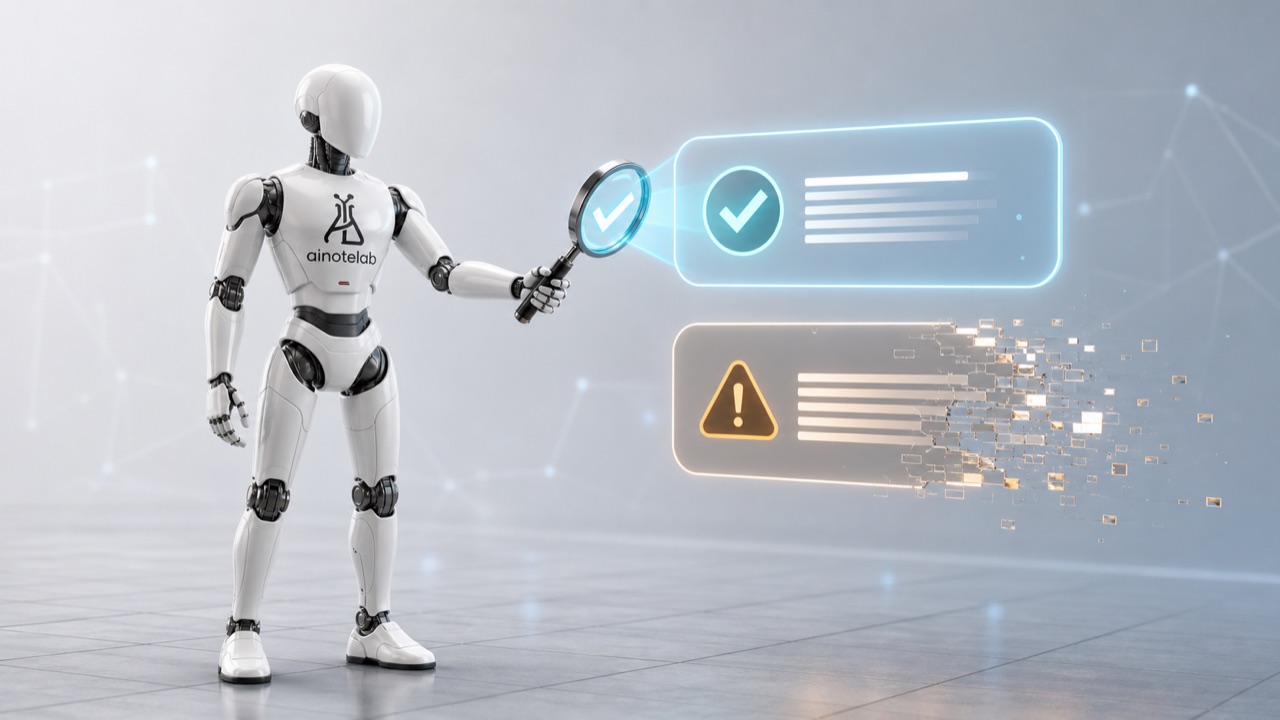
An AI once gave me a book quote complete with a page number. The sentence was perfect, the tone was confident, and the quote did not exist anywhere in that book. This is what we call hallucination — an AI stating things that aren't true with the delivery of someone who is absolutely sure.
Hallucination isn't a bug — it's a byproduct of how AI works
Many people think of hallucination as "the AI malfunctioning," but it's closer to the AI doing exactly what it was built to do. As covered in how LLMs work, a language model's core job is predicting "the most plausible next word." The key word is plausible — not true.
For topics that appear frequently in training data, plausible and true mostly overlap. No model gets "who wrote Romeo and Juliet" wrong. The trouble starts with topics the training data rarely covered. Faced with those, the model leans toward "complete the sentence convincingly" rather than "admit I don't know" — and that's how you get a fake quote with a page number attached.
Question types that deserve extra suspicion
- Specific numbers, dates, statistics — ask for an exact figure and it will confidently invent a similar-looking one.
- Quotes and citations — paper titles, book passages, case numbers. The perfect formatting makes them more dangerous, not less.
- Obscure people, places, products — the thinner the source material, the more it fills gaps with imagination.
- Recent events — anything after the model's training cutoff is unknowable to it, yet it sometimes answers as if it knows.
- Fields you can't verify yourself — the less you know about a domain, the less you can filter wrong answers, so your real risk goes up.
5 practical ways to reduce hallucination
- 1. Add "if you don't know, say so" upfront — this one line in your prompt noticeably raises the rate of honest "I'm not sure" answers instead of fabrications.
- 2. Ask for sources with the answer — models tend to self-filter claims they can't attach a source to. But sources themselves can be invented, so actually click the links.
- 3. Use a search-connected tool for facts — if fact-finding is the goal, a search-based AI like Perplexity that cites live web sources is safer than a chatbot.
- 4. Ask two AIs the same question — when two models disagree, that's a strong signal one of them is making things up.
- 5. Verify only the load-bearing facts — checking an entire answer is impractical. Pick out the proper nouns, figures, and quotes, and verify just those with a search.
Why we still use AI anyway
Hallucination doesn't make AI useless. For tasks where you can verify the output yourself on the spot — summarizing, drafting, brainstorming, explaining code — the damage from hallucination is small and the efficiency gain is large. The most dangerous usage pattern is treating AI purely as a way to learn facts you have no means of checking. Know the tool's strengths and weaknesses, and assign it the right jobs.