
Physical AI Is Coming: Where It Stands and Where It Will Enter Daily Life First
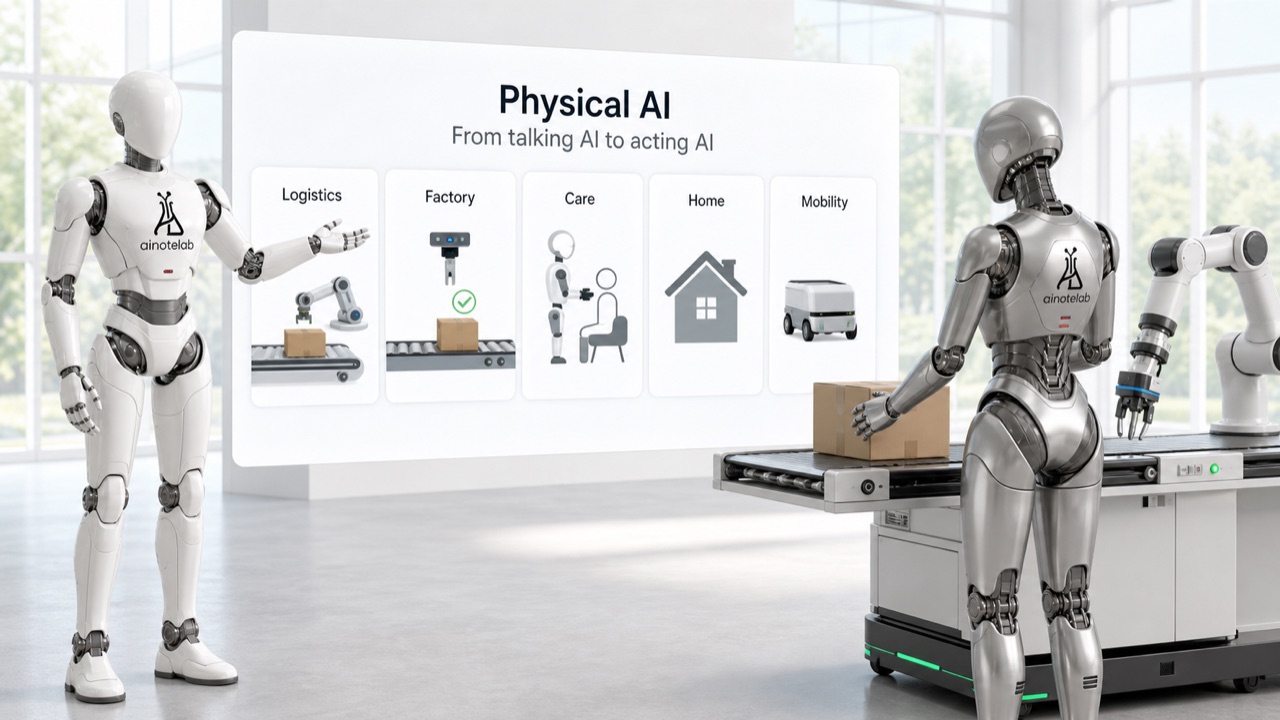
Physical AI is coming, but the phrase needs precision. It does not simply mean “robots are trendy.” It means AI systems are beginning to perceive physical environments, reason about objects and people, and take actions through robots, vehicles, drones, or industrial machines.
Text and image models operate mostly in the digital world. Physical AI operates in the world of friction, weight, distance, safety, clutter, and accidents. That is why it is more difficult and more consequential.
What Physical AI Means
Physical AI, often discussed alongside embodied AI, combines perception, reasoning, control, and learning. A robot must see the scene, understand an instruction, plan a sequence of actions, and execute them safely. If a chatbot makes a bad sentence, it can be edited. If a robot grabs a glass badly, it can break the glass or hurt someone.
Where the Technology Stands in 2026
The practical answer is uneven. Industrial and logistics use cases are already real. General-purpose home humanoids are still early. The strongest adoption begins in constrained spaces: factories, warehouses, stores, hospitals, farms, and roads where the task can be defined and measured.
| Stage | Status | Examples |
|---|---|---|
| Fixed automation | Mature | Industrial arms, inspection, sorting |
| Limited autonomous mobility | Commercializing | Cleaning robots, AMRs, delivery robots |
| Language-guided manipulation | Early deployment | Humanoids picking, sorting, tidying |
| General home and field assistance | Still early | Broad household work, elder care, complex sites |
Leading Companies
NVIDIA is a key infrastructure player. Cosmos focuses on world models and simulation for Physical AI, while GR00T N1 targets foundation-model learning for humanoid robots. NVIDIA is effectively building the training and simulation stack that lets robots learn before being deployed in the real world.
Figure AI is one of the most visible humanoid companies. Its Helix direction emphasizes vision-language-action control: seeing objects, understanding instructions, and turning them into action.
Tesla is important because of Optimus and the company’s manufacturing base. For Physical AI to become mainstream, mass production, batteries, motors, cost, safety, and maintenance matter as much as model intelligence.
Boston Dynamics, Agility Robotics, 1X, and Sanctuary AI represent different paths toward robots that can work in human-designed spaces.
Where It Will Enter Daily Life First
Physical AI will not appear everywhere at once. Warehouses and factories come first because tasks are repetitive and ROI is clear. Hospitals and care facilities follow with delivery and support roles. Homes come later because every home is different, cluttered, and socially sensitive. Autonomous vehicles and delivery robots are already among the most visible Physical AI systems, but they depend heavily on regulation and infrastructure.
Advantages
- It can ease labor shortages in logistics, manufacturing, and care.
- It can reduce dangerous and repetitive work.
- It can improve quality control and operational consistency.
- It can eventually support older adults and busy households.
Problems and Risks
- Safety: robots move around people and must obey strict limits.
- Data: real manipulation data is expensive and hard to collect.
- Cost: sensors, actuators, batteries, and compute remain expensive.
- Reliability: demo success is not the same as daily reliability.
- Privacy: home robots may see and hear deeply personal spaces.
- Liability: responsibility must be defined when physical damage happens.
Conclusion
Physical AI is real, but it should be understood in stages. The near-term wave is industrial, logistics, inspection, mobility, and limited service work. Home robots will come more slowly, beginning with narrow tasks before becoming broad assistants. The deeper shift is that AI is moving from answering questions to acting in the world.