
The 5 Stages of Becoming an AI Power User
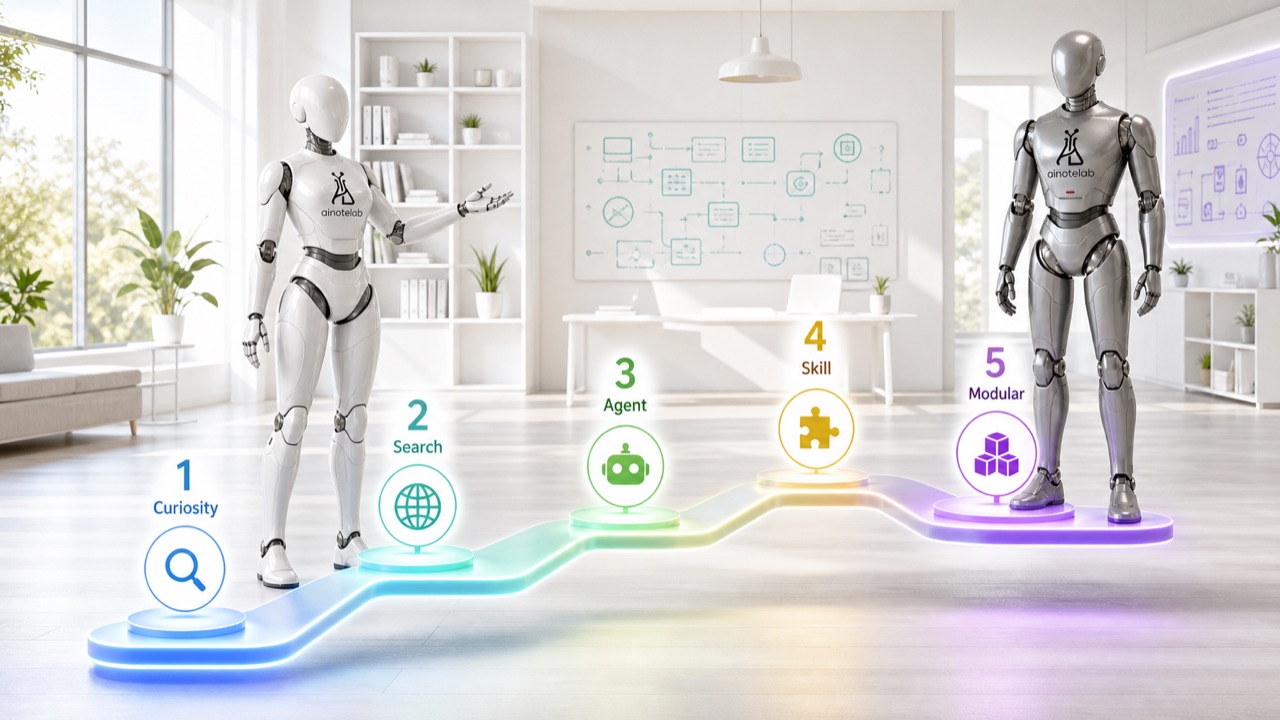
The AI era is supposedly here, but the people around us use it very differently. One coworker finishes a day of work before lunch. Another says, "I tried it. It was nothing special." Is it a talent gap? Not really. They are just stuck at different stages.
Borrowing the language of AI maturity models, a person's AI adoption can be viewed as five practical stages. The problem is that every stage has a very real wall. Time alone does not move people forward.
This article walks through what each stage looks like, what people think when they stop there, and what changes for the people who move on.
Stage 1: Curiosity, "Write a silly poem"
Maturity sense: Awareness
Someone at dinner shows a chatbot on their phone. Everyone laughs as it writes a joke, a poem, or a quick answer. That night you install the app and ask random questions for half an hour.
Two weeks later, the app is buried in a folder.
"It is interesting, but what am I supposed to do with it?"
The novelty of talking to AI expires quickly. After a few generic answers or one confident hallucination, many people conclude that it is a talking toy.
The people who move on usually have one moment when AI helps in a real situation: a late-night health question that needs careful checking, a last-minute meeting opener, or a quick explanation before a work task. The first useful moment turns the toy into a tool.
Stage 2: Search replacement
Maturity sense: Active
Now you open AI before a search engine. You ask about spreadsheet formulas, email drafts, report wording, and travel plans. It starts to feel inconvenient not to have it.
Then, right when you need it, the limit appears: "You have reached the usage limit. Try again later or upgrade."
"Twenty or thirty dollars a month? Do I really use this well enough to pay for it?"
This is where many people stop. The issue is not only the fee. It is self-doubt: "Am I good enough at using this tool to justify paying?"
The people who move on calculate time. If AI saves two hours a month, the subscription is no longer entertainment. It is a tiny labor cost. Others move after seeing a colleague produce better work faster with the paid version.
Stage 3: Agent-style use
Maturity sense: Operational
After subscribing, you begin assigning roles. "You are a senior marketer. Draft a product launch plan." The output looks useful, so you bring it into real work.
Then reality hits. AI does not know your company's internal terms, last year's performance context, or the exact government template. You submit the draft and get it back covered in edits.
"If I have to rewrite everything, I may as well write it myself."
Most people who leave this stage tried to hand over the whole job. Whole reports and whole plans often produce polished but unusable results.
The people who move on change the unit of work. Instead of "write the proposal," they ask: "find the weak logic," "rewrite this paragraph for executives," or "list five objections to my argument." AI becomes a reviewer and thinking partner, not a replacement worker.
Stage 4: Repeatable skills
Maturity sense: Systemic
You now have a feel for prompts. You may have custom GPTs or project spaces. You can drop in a spreadsheet and get a rough chart or report. People at work start asking you to "try it with AI." It feels good.
But the day still looks strange: open email, copy content into AI, paste the summary into Notion, share it in Slack. AI is useful, but you are still the copy-and-paste bridge.
"The individual tasks work, but I still connect everything by hand. Automation sounds like something for developers."
The work is fragmented. Each AI task helps, but the flow is still manual. Many people stop because they assume this is the end of non-developer AI use.
The question has to change from "What should I ask AI?" to "Can I remove this repetition entirely?" Tools such as n8n and Make show that no-code automation can connect the blocks without becoming a full-time developer.
Stage 5: Modular AI
Maturity sense: Transformational
At this stage, AI is no longer a separate window. It becomes a module inside a workflow.
Customer email received → AI classifies, summarizes, and estimates urgency → the result is stored in a Notion database → only urgent items are sent to Slack
The flow keeps working after office hours. In the morning, twenty messages may already be sorted, and only two urgent ones need attention. While others use AI, this person designs a system where AI works.
The personal chasm
New technologies often face a chasm between early curiosity and mainstream use. The same thing happens personally. The biggest drop-offs are usually between Stage 2 and Stage 3, and between Stage 3 and Stage 4.
If you are stuck at the cost wall
Translate the subscription into labor cost. If it saves more than two hours a month, the decision is easier. If it does not, the free version may be enough.
If you are stuck at the work-application wall
Do not hand over the entire job. Split your work into ten pieces and give AI the smallest, most boring piece first: ten ideas, typo checking, spreadsheet formulas, objection lists. AI looks weak when you ask for the whole job, but useful when the unit is right.
Closing thought
AI literacy is not about fancy prompt tricks. It is the ability to judge the value of time saved, break work into useful pieces, and place AI modules where they actually help.
Which stage are you in now? And is the wall really impossible, or have you simply not found a reason to cross it yet?