
The Moments AI Writing Loses Its Human Touch
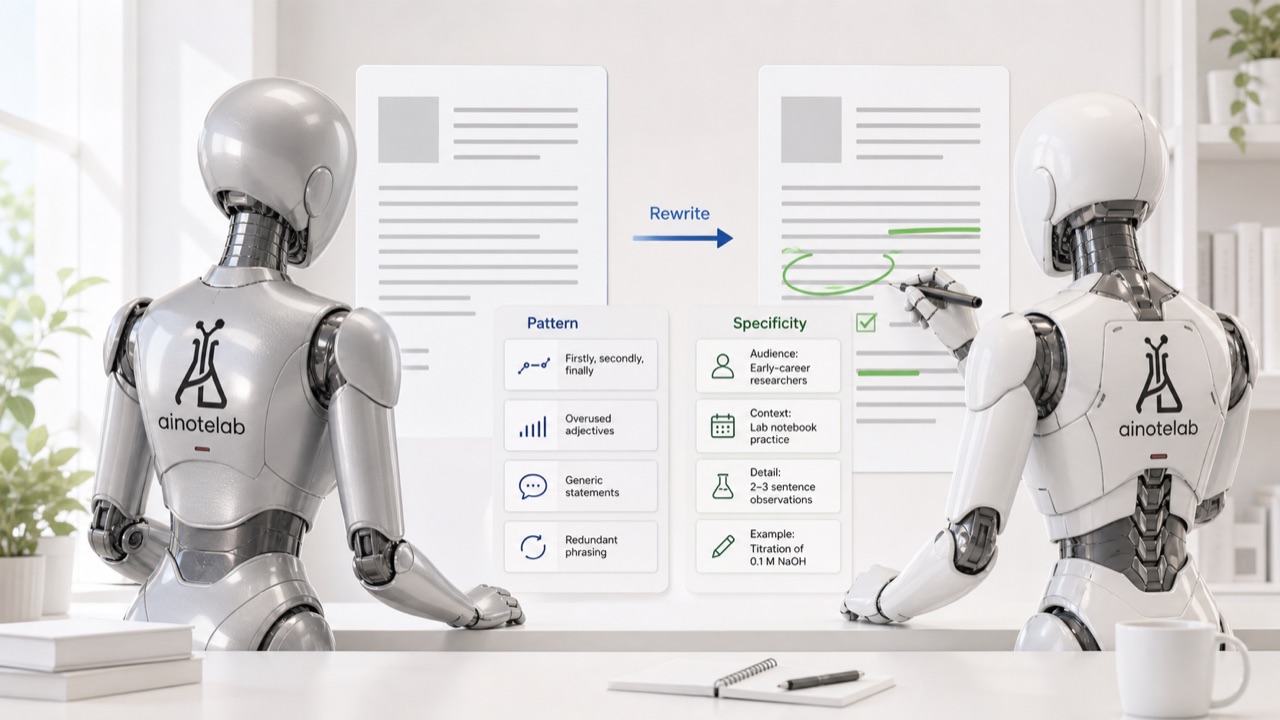
AI-written text has correct grammar and smooth logic, yet a few lines in, something faintly mechanical shows through. I wanted to know what that something was. So I generated 20 AI pieces across 4 genres (personal essay, product intro, travelogue, apology letter) and went through them with a highlighter, marking exactly where the human touch vanished.
The 6 patterns I found
1. Everything comes in threes
"First…, second…, third…" — the three-part structure recurred in 14 of the 20 pieces. Human writing sometimes fixates on one point and runs long, or piles up five; AI converges on a balanced three. The balance itself turned out to be the tell.
2. Experiences without scars
Most visible in the travelogues. "The coffee at a café I stumbled upon in a side street was an unforgettable taste" — plausible, but there's never a story about the coffee going cold and tasting bad, or getting lost and arguing. Experience stories with no failure and no concrete inconvenience were the single biggest signature of AI writing.
3. The safe both-sides ending
"In the end, what matters is balance." "There's no right answer — find what works for you." Four of the five essays ended with a sentence like this. A conclusion nobody can argue with leaves no impression on anybody.
4. Emotions are explained, not shown
It writes the emotion words outright: "I was deeply moved," "I felt a pang of sadness." Good human writing leaks emotion through action — "I stood in front of it for a long time."
5. Flawless vocabulary, flawless sentences
The crumbs of spoken language ("anyway," "kind of," "how do I put this"), half-broken sentences, regional turns of phrase — this "imperfection" is completely absent. Every sentence is correct, which is exactly why the whole feels alien.
6. The clincher, from the apology letters — the missing specific wrongdoing
The apology experiment was the most interesting. AI's apologies nail the "we sincerely apologize for the inconvenience" part, but keep smearing over exactly what went wrong. Naming the specific fault creates liability, and the AI seemed to dodge that risk instinctively — statistically, rather.
I also tested fixes for bringing the human touch back
- Feeding in 2–3 of my real experiences as raw material — best result by far. Instantly fixed problem 2 (experiences without scars).
- "Pick one side in the conclusion" — escapes the both-sides ending (problem 3).
- "Do not use emotion words (moved, happy, sad)" — forcing a detour around problem 4 made the writing noticeably better.
- "It's fine to leave one imperfect sentence in" — it works, but occasionally comes out cringingly forced. Half a success.
What I learned
The awkwardness of AI writing isn't a lack of craft — it's the voice of a narrator with nothing at stake. Failure stories, positions, responsibility: human writing has skin in the game, and AI writing doesn't. So the fixes all boil down to one move: put the stakes in yourself — your experience, your position — as raw material. Use the AI to add flesh; the bones must be yours.