
Lab Notes · 5
Short Prompts vs. Long Prompts — The Break-Even Point on Length
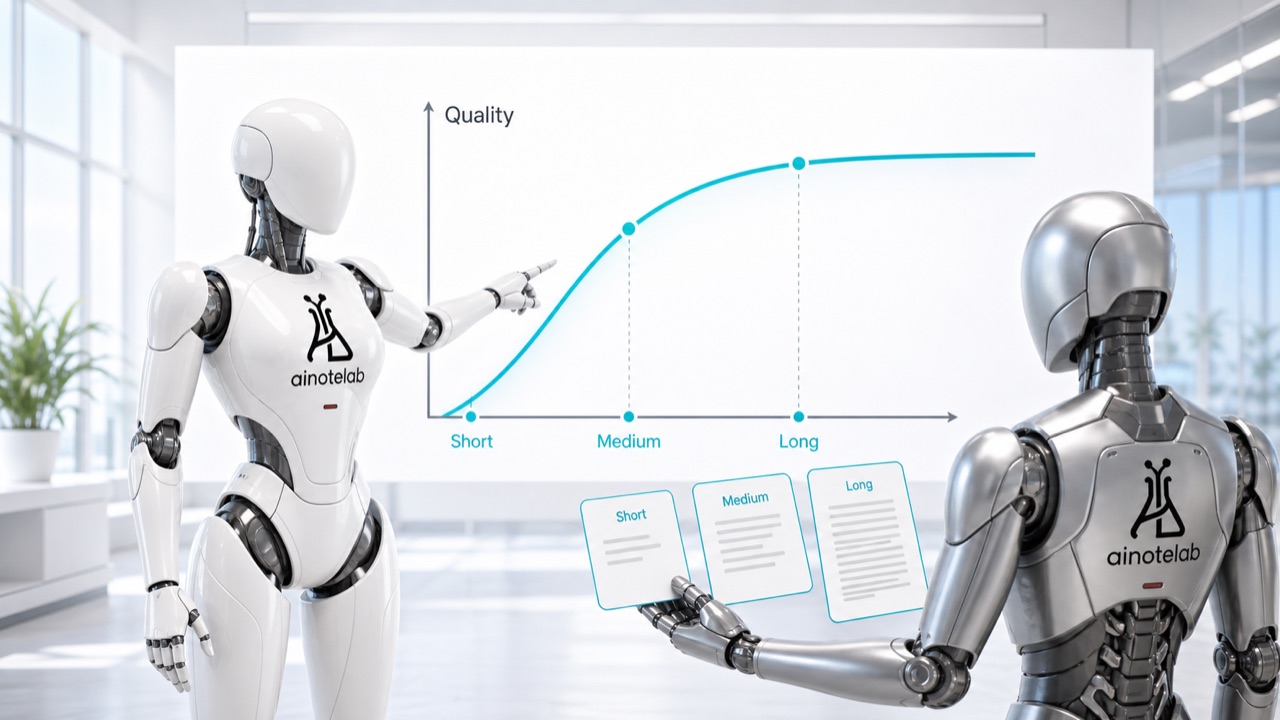
"The more detailed the prompt, the better" — I've said it on this blog more than once. But how detailed is detailed enough? Is longer always better, without limit? I ran the same task through five prompts, changing only the length.
Setup
Fixed task: "write Instagram promo copy for a neighborhood bakery's new item (a salt bread roll)." I prepared prompts at five length tiers.
- ~10 characters: "Write promo copy for salt bread"
- ~50 characters: + it's a neighborhood bakery, and it's for Instagram
- ~150 characters: + target audience (20s–30s), tone (friendly), length (2 sentences + hashtags)
- ~300 characters: + the shop's personality (dough mixed at 4:30 a.m., French butter), phrases to avoid (no "crispy outside, soft inside")
- ~500 characters: + 2 examples of good copy, the brand story, event details, an expanded list of banned phrases
Results
| Tier | Verdict |
|---|---|
| 10 chars | Copy you could paste onto any bakery. In other words, not ours |
| 50 chars | Still generic. Mostly stock phrases like "freshly baked" and "a happy bite" |
| 150 chars | The big jump happens here. With length and tone pinned down, it's postable as-is |
| 300 chars | The shop's unique details (pre-dawn dough, the butter) become the heart of the copy. Peak quality |
| 500 chars | About the same as 300, or subtly stiffer. It felt boxed in by the examples' style |
Observation: a curve of diminishing returns
Quality did not scale with length. It climbed steeply from 10 to 150 characters, peaked at 300, then flattened — or dipped slightly. Digging into why the 500-character tier dipped, I found two reasons.
- With too many conditions, the AI focuses on satisfying them and sacrifices the naturalness of the writing.
- Examples improve control, but if the examples are mediocre, the output levels down to match them.
What I learned
- What mattered wasn't length but the kind of information, in this order: ① purpose & length ② audience & tone ③ details only you have. The moment the unique detail (dough at 4:30 a.m.) went in was the real inflection point.
- The essence isn't "write long" — it's "include what's uniquely yours." 300 characters of flowery filler would be no better than 10.
- Examples are a double-edged sword. Attach them only when you have genuinely good ones.
The practical rule of thumb: fill in roughly three sentences — what, for whom, and what's uniquely ours — and your prompt becomes "long enough" on its own. Don't count characters; count pieces of information.