
What Is AI? Artificial Intelligence Explained in One Go
The news, the office, YouTube — AI is everywhere. Yet when someone actually asks, "So what exactly is AI?", a clear answer is surprisingly hard to give. In this post, I'll untangle three words — artificial intelligence (AI), machine learning, and deep learning — and how they relate to each other, all in one go. Understand just this much, and most AI news articles will suddenly start making sense.
Artificial Intelligence: The Biggest Umbrella
Artificial intelligence (AI) is the broadest term of all — it covers "any technology that appears to think or make judgments the way a person does." The term has been around since the 1950s, and it spans everything from the very simple to the cutting edge.
The enemy character chasing you in a video game, the filter that catches spam email, and ChatGPT can all be called artificial intelligence. In other words, AI isn't one specific technology — it's closer to a name for a goal: intelligent, human-like behavior.
Machine Learning: Teaching Instead of Hand-Coding Rules
Early AI relied on humans programming rules one by one — things like "if the subject line contains 'loan,' mark it as spam." But the world is far too messy to capture in a handful of rules.
That's where machine learning comes in. Instead of humans writing the rules, you show the computer piles of data and let it discover the patterns on its own.
Show it 100,000 spam emails and 100,000 legitimate ones, and the computer figures out for itself that "messages with these traits are probably spam." That process is called training.
It's the same way a child who's seen a hundred photos of dogs learns to recognize a dog — without anyone ever spelling out the rules.
Deep Learning: Machine Learning That Mimics the Brain
Deep learning is one particular approach to machine learning. It stacks artificial neural networks — structures modeled on how neurons connect in the human brain — many layers deep (hence "deep").
The deeper the layers, the more complex the patterns it can learn. In the 2010s, computing power (especially GPUs) and data exploded, and deep learning took off with it. That's when image recognition, speech recognition, and translation all suddenly got good. Every modern AI system, including ChatGPT, is built on deep learning.
How the Three Fit Together, in One Sentence
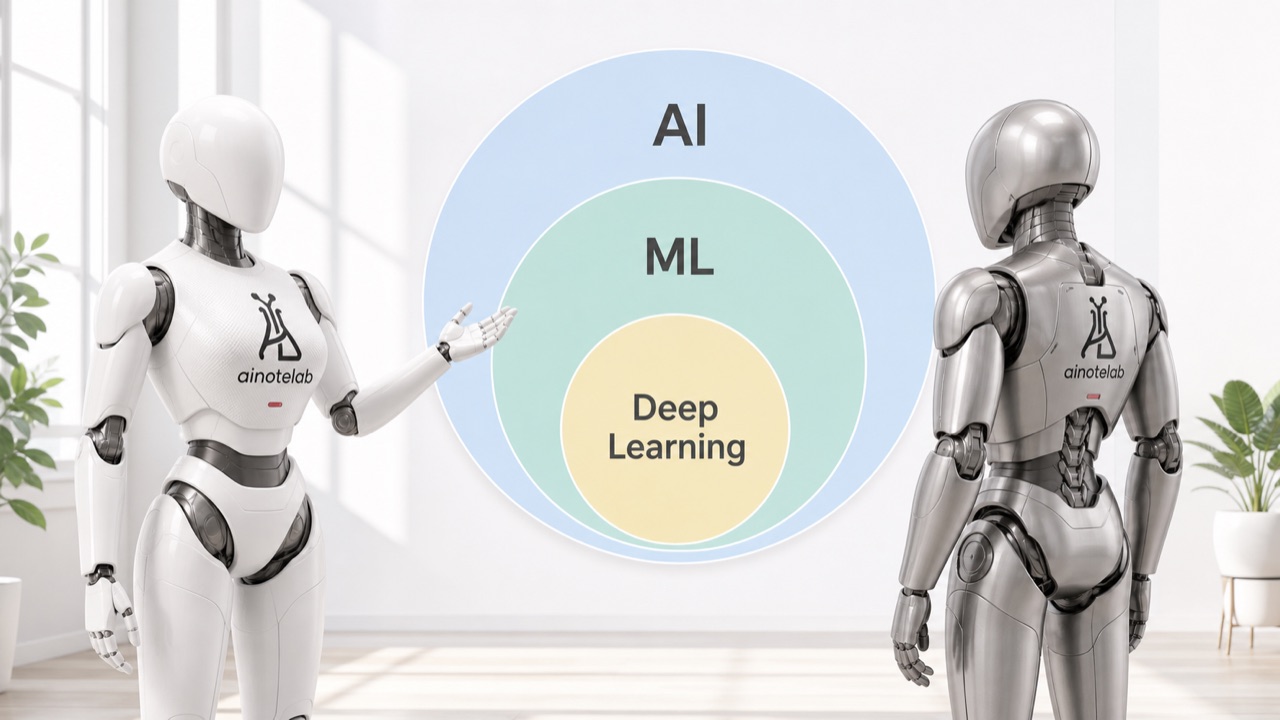
To sum up, they nest inside each other like Russian dolls (matryoshka).
| Concept | One-line definition | Examples |
|---|---|---|
| Artificial Intelligence (AI) | Any technology that behaves intelligently, like a human | Game NPCs, navigation route finding |
| Machine Learning (ML) | An AI approach that learns patterns from data on its own | Spam filters, product recommendations |
| Deep Learning (DL) | Machine learning built on deeply stacked neural networks | Face recognition, ChatGPT, self-driving cars |
AI ⊃ machine learning ⊃ deep learning. "Deep learning is a kind of machine learning, and machine learning is one way to build AI" — that one sentence is all you need.
So What About the 'Generative AI' Everyone Talks About?
What set the world abuzz after ChatGPT arrived in late 2022 is generative AI. Where traditional AI mostly "classified and predicted" (Is this email spam? Will the stock go up tomorrow?), generative AI creates new content — text, images, music, and video. It's another branch of deep learning, and we'll dig into it in Part 3.
Today's Takeaways
- AI isn't a single technology — it's a broad term for the goal of "intelligent behavior."
- Machine learning means learning patterns from data instead of hand-coding rules.
- Deep learning is machine learning with deeply stacked neural networks, and it's the driving force behind today's AI boom.
- Generative AI like ChatGPT uses deep learning to create content.
In the next post, we'll dig into how large language models (LLMs) like ChatGPT manage to produce speech that sounds so human.